

A compliance analyst gets an “urgent” escalation at 8:12 a.m. A sales manager has forwarded a screenshot of a chat thread that appears to show a client approving an exception to the standard due diligence workflow. The message looks casual, even familiar. The timestamps line up. There is a logo in the corner. The analyst is asked for one thing: confirm it, file it, move on.
This is how document tampering works in real organizations. It rarely arrives as a dramatic forgery with obvious red flags. It arrives as something that feels routine. A screenshot. A PDF. A “just for the record” image dropped into Slack. A scanned letter uploaded to a ticket.
By 2026, the challenge is not that teams lack policies. It’s that evidence has become too easy to fabricate, too cheap to scale, and too fast to circulate. Compliance and risk teams now need a practical way to answer a simple question at intake: Is this real?
The new normal: believable fakes, low effort, high leverage
A decade ago, producing a convincing fake document usually required editing skills, specialized tools, and enough time that many bad actors moved on. That barrier is gone. A screenshot can be generated to support almost any narrative, whether it’s a fake approval, a fake threat, or a fake “customer request” that conveniently justifies an out-of-policy action.
The point is not that everyone is forging evidence. The point is that the ease of fabrication changes behavior at the margins. It enables internal policy workarounds. It supports opportunistic fraud. It complicates investigations. And it forces compliance teams to spend time validating artifacts that used to be assumed legitimate.
You can see the ecosystem in plain sight. Tools built for harmless uses can also be used for deception. A site like fake whatsapp chat can help creators storyboard a skit, build a UX mockup, or generate a classroom example. It can also, with the same UI, produce “evidence” for a dispute, a chargeback, or an HR claim. The technology is neutral. The risk comes from how quickly a plausible artifact can be produced and inserted into a business process.
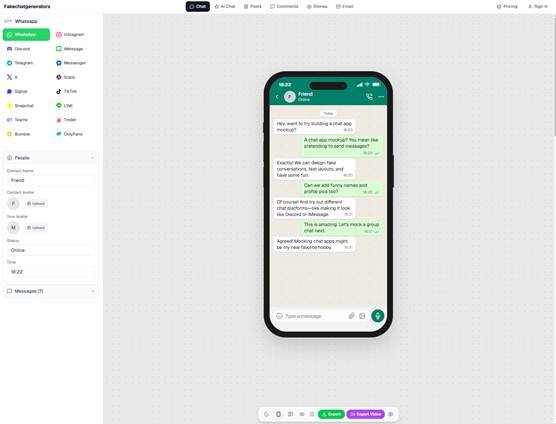
fakechatgenerators.com lets you mock up chat screenshots across 16 platforms
Where tampering shows up in compliance workflows
Most organizations don’t have a single “document tampering” queue. The problem is distributed across functions, and that’s why it causes so much friction. Here are the common places it lands.
1) KYC, onboarding, and identity verification
Banks, marketplaces, and regulated fintech teams regularly review documents that can be tampered with: proof of address, bank statements, pay stubs, business registrations, invoices. Even when a document is “real,” it may be altered, a name changed, an address swapped, a date nudged to meet eligibility windows.
When onboarding is under SLA pressure, reviewers are incentivized to clear cases quickly. That creates a soft spot: a forged file that looks “good enough” can slip through, especially if the applicant responds promptly and behaves like a legitimate customer.
2) Expense, procurement, and vendor management
Receipts and invoices are classic targets because they are easy to alter and often reviewed at scale. A few edited line items, a different vendor name, a slight change to totals. In procurement, documents can be altered to retroactively “prove” that a competitive bid took place, or that a contract clause was accepted.
This is not just a financial control issue. It becomes a compliance issue when it touches bribery risks, conflicts of interest, and auditability.
3) Customer support, chargebacks, and disputes
Dispute resolution teams live on screenshots. A customer claims a representative promised a refund. A merchant claims a buyer agreed to a delivery exception. A platform moderator receives “proof” of harassment. These files are often the only evidence presented, and they tend to arrive as compressed images with stripped metadata.
The operational cost here is real. Every ambiguous artifact expands handling time. Worse, inconsistent outcomes create reputational risk and escalation load.
4) HR and internal investigations
HR teams see edited screenshots in harassment claims, performance disputes, and allegations of policy violations. Investigators often need to triage quickly: decide whether a case requires deeper review, legal involvement, or immediate safety measures.
A fabricated screenshot can cause irreversible harm, even if disproven later. That’s a painful truth, and a reason compliance leaders increasingly treat media authenticity as a first-class control, not a “nice to have.”
Why traditional controls are not enough
Most organizations already use a mix of controls:
- Manual review by trained analysts
- Document checklists and “required fields”
- Watermarks, signing workflows, and PDF protections
- Random sampling and post-approval audits
- Metadata checks when available
These controls still matter. But they struggle in 2026 for three reasons.
First, screenshots bypass structured data. A screenshot is a dead end from a data validation standpoint. It’s a picture of a conversation, not the conversation. It doesn’t carry authoritative headers, server signatures, or API logs.
Second, metadata is fragile. Many platforms strip metadata automatically. Files moved through messaging apps and ticketing systems lose context. Even when metadata exists, it can be manipulated.
Third, humans are overloaded. A good forgery is designed to exploit attention. Reviewers are juggling dozens of cases, each with its own nuance. They are not doing pixel-level analysis at 4:45 p.m. on a Friday.
Compliance teams need an additional layer that works at intake speed and can flag risk without requiring an expert to squint at every image.
What “AI detection” actually does for compliance teams
AI detection is often misunderstood as a magic lie detector. It isn’t. In a compliance setting, its value is more practical: it gives you a defensible triage signal and a consistent way to route questionable artifacts for deeper review.
In broad terms, a strong detection system can help with:
- AI-generated media detection: identifying images created by generative models
- Document tampering detection: spotting edits, splices, or synthetic elements in a “real-looking” file
- Content classification: flags for NSFW content, violence, or other policy categories
- Workflow integration: running checks automatically as files enter a queue
The operational goal is to reduce two failures: letting a fake sail through, and forcing senior reviewers to spend their time on low-risk cases.
A specialized tool like an ai image detector positions itself directly in that gap. It claims 98.7% detection accuracy across 50+ generative models (including Midjourney, DALL-E, Stable Diffusion, Flux, Ideogram, Google Gemini, and GANs) with sub-150ms latency, and it’s already used by journalists, content moderation teams, trust and safety platforms, banks, marketplaces, and legal teams. For compliance leaders, those numbers matter less as marketing and more as workflow design constraints. If detection is fast enough, it can run on every upload. If it’s accurate enough, it can reduce manual load without generating constant false alarms.
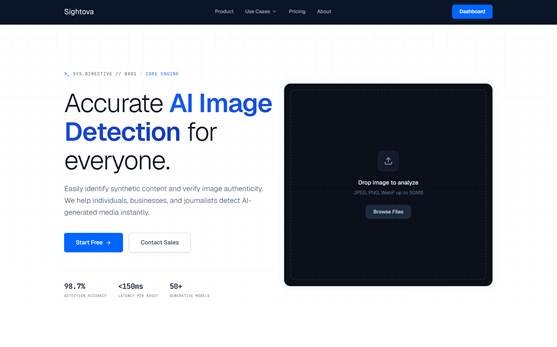
sightova.com flags AI-generated, tampered, NSFW, and violent imagery in milliseconds
A realistic model: detection as a triage layer, not a verdict
The best way to implement detection is to treat it like a metal detector at an airport. It doesn’t prove guilt. It identifies what needs a closer look.
A practical triage approach often looks like this:
- Ingest: Every uploaded image or document is scanned automatically.
- Score: The system returns a likelihood or classification (AI-generated, tampered, sensitive content categories).
- Route:
- Low-risk items proceed through normal review.
- Medium-risk items require additional corroboration.
- High-risk items escalate to a senior reviewer or a specialist queue.
- Corroborate: Investigators ask for supporting artifacts (original file, email headers, platform exports, transaction logs).
- Document: The case file records that authenticity screening occurred, including timestamps and system output.
That last step is easy to overlook, but it’s crucial. When auditors or regulators ask how you made decisions, “we trusted the screenshot” is not a great answer. “We screened the artifact on intake and escalated based on risk signals” is better, even when the final decision still requires human judgment.
What to do when a file is flagged
A flag should trigger a playbook, not a panic. The playbook depends on the function, but the pattern is similar.
Ask for the original, not the forwarded copy
Forwarded screenshots are the easiest to manipulate and the hardest to validate. Request the original file, exported directly from the source platform when possible.
Seek an independent record
If the screenshot claims an approval, look for the approval in the system of record: ticketing tools, CRM notes, signed exception forms, audit logs. If it’s a chat approval, ask for the actual message link or platform export. If the platform cannot provide a verifiable record, treat the screenshot as untrusted.
Check for consistency, not perfection
Tampering often leaves narrative seams: inconsistent timestamps, missing preceding messages, mismatched time zones, sudden shifts in tone. You are not doing forensic art analysis. You are checking whether the artifact fits the business context.
Escalate proportionally
Not every flagged item is malicious. Marketing teams use mockups. Product teams use fabricated conversations for UX demos. Journalists and researchers use synthetic examples for safety. The key is to align escalation with impact. A flagged image attached to a low-risk internal training deck is different from a flagged document used to approve a high-risk customer or override a sanctions control.
The compliance upside: fewer bottlenecks, cleaner audits, calmer escalations
When authenticity screening is built into workflows, the impact shows up in mundane but meaningful ways.
- Shorter investigations: fewer dead ends caused by fabricated “evidence.”
- Better consistency: similar artifacts get similar treatment, regardless of which analyst is on shift.
- Reduced social engineering: employees learn that screenshots are not a shortcut around policy.
- Improved audit readiness: you can show that media entering sensitive workflows is screened and routed based on risk.
It also changes internal conversations. Instead of arguing about whether someone’s screenshot “looks real,” teams can focus on what matters: corroboration, intent, and control gaps.
Implementation notes that matter in 2026
Compliance buyers tend to ask the right questions, but sometimes in the wrong order. A few considerations deserve to be early in the evaluation.
Latency and scale
If detection adds friction, people will route around it. Sub-150ms latency is not a nice technical detail. It’s the difference between “always on” and “only used for high-risk cases.”
Coverage across models and manipulation types
Generative models evolve quickly, and tampering is not limited to full synthetic images. You need broad coverage: classic edits, splices, and AI-generated components.
Integration into existing systems
If your reviewers live in case management tools, the detection signal needs to show up where they work. The most effective implementations run automatically at upload, store the result in the case record, and trigger routing rules without manual steps.
Governance and human review
AI detection should have owners. Decide who can override a flag, what additional evidence is required, and how to handle false positives. Governance is what keeps the tool from becoming a noisy dashboard.
The uncomfortable truth: “proof” has become a product
It is now possible to manufacture plausible proof as easily as writing a message. That changes the cost of dishonesty. It also changes the cost of being diligent.
Compliance teams are not trying to win a philosophical argument about reality. They are trying to keep workflows moving while meeting regulatory obligations and protecting customers. AI detection helps by turning authenticity from a subjective debate into a repeatable control. Not perfect, not final, but fast enough and consistent enough to matter.
In 2026, the teams that handle document tampering well will not be the ones with the most skeptical reviewers. They’ll be the ones who designed intake systems that assume media can be manipulated, then built calm, documented processes to verify what needs verifying. That is what saves time. It also saves reputations.