
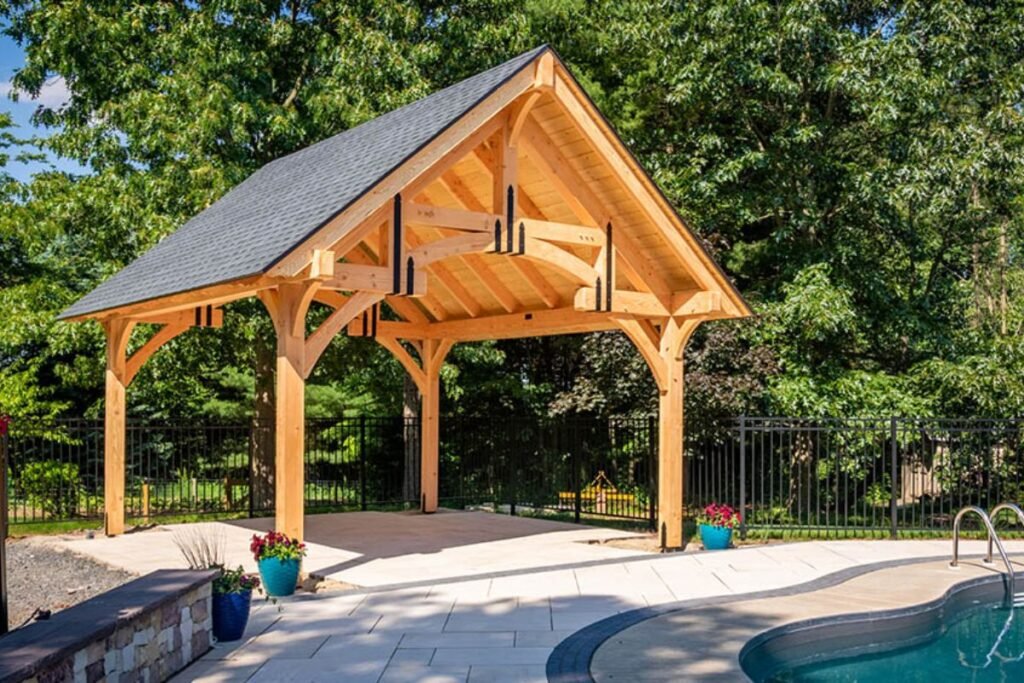
Outdoor entertaining has transformed from a seasonal luxury to a year-round lifestyle priority for homeowners across North America. The key to making this happen is choosing the right structure that combines style, functionality, and weatheradaptability. A heavy timber pavilion serves as the perfect foundation for creating memorable gatherings with family and friends, regardless of the season.
Whether you’re planning a heavy timber pavilion USA project in sunny California, snowy Colorado, or exploring a heavy timber pavilion Canada installation in Ontario or British Columbia, the addition of strategic features like fire pits, outdoor kitchens, and louvered roof systems transforms a simple shelter into a true outdoor living space. Let’s explore how to design and customize a heavy timber pavilion that works year-round in your climate.
The Foundation: Understanding Heavy Timber Pavilion Construction
Before diving into add-ons and features, it’s important to understand what makes a heavy timber pavilion the ideal platform for year-round entertaining. Heavy timber pavilions are constructed using substantial timber members—typically 6×6, 8×8, or larger posts with matching beam structures. These massive wood elements are far more than aesthetic choices; they provide the structural integrity needed to support additional features like kitchen appliances, heating systems, and specialized roofing.
The solid construction of timber frame pavilions, combined with premium materials like Douglas Fir or Western Red Cedar, creates a structure that ages beautifully while remaining structurally sound for decades. This durability is essential when you’re planning to invest in permanent features like outdoor kitchens or complex louvered roof systems.
Fire Pit Pavilions: Creating Warmth and Atmosphere
Why Fire Pits Belong Under a Timber Pavilion
A fire pit adds more than ambiance to a heavy timber pavilion; it extends your entertaining season significantly. Fire pits combat cooling temperatures in spring and fall, allow comfortable outdoor gatherings in winter, and create a gathering point that naturally draws people together.
The structural support of heavy timber allows you to safely integrate a fire pit feature into your pavilion design. Unlike lightweight structures, a robust timber frame can accommodate the heat, smoke, and occasional sparks without concern.
Fire Pit Design Options
Stone-Built Fire Pits
The most traditional and elegant approach, stone fire pits work beautifully under timber pavilions because they complement the natural materials. Constructed from fieldstone, limestone, or stacked stone, a built-in fire pit becomes a permanent architectural feature. Stone provides excellent heat retention and creates a rustic aesthetic that pairs perfectly with exposed timber beams.
Metal Fire Pits and Rings
Modern metal fire pits offer flexibility and cleaner lines. Fabricated steel rings, cast iron bowls, or custom metal designs can be installed below a timber pavilion with proper ventilation. Metal pits work particularly well in contemporary timber pavilion designs that blend rustic wood with sleek modern elements.
Brick or Concrete Fire Pits
Durable and versatile, brick and concrete fire pits work well for both traditional and modern pavilion designs. These materials age gracefully, developing patina and character similar to the wood overhead.
Ventilation and Safety Considerations
A critical element of fire pit design is proper ventilation. Your heavy timber pavilion needs adequate height and openness to allow smoke to escape without making the space uncomfortable. Industry standard recommends at least 12 feet of clearance above the flame, though higher is better for comfort.
Year-Round Fire Pit Entertaining
A fire pit extends your entertaining season from roughly 8 months per year (with a basic pavilion) to 12 months. Winter gatherings become intimate and cozy, while spring and fall entertaining shifts from “nice if the weather cooperates” to completely comfortable year-round.
The psychological comfort of sitting around a fire pit under massive timber beams creates a timeless entertaining experience that resonates across all demographics and regions.
Outdoor Kitchens: Transforming Your Pavilion into a Culinary Destination
The Case for Outdoor Kitchens Under Timber Pavilions
An outdoor kitchen fundamentally changes how you use your heavy timber pavilion. Instead of running back and forth to your indoor kitchen, you can prepare and serve food entirely outdoors while remaining engaged with your guests.
Heavy timber pavilions are structurally ideal for outdoor kitchens because they provide:
- Overhead weather protection for equipment and food prep
- Structural support for gas or electric connections
- Adequate headroom for ventilation hoods and grills
- Solid framing for electrical and water infrastructure
Essential Outdoor Kitchen Components
Grilling Stations
High-quality built-in grills are the centerpiece of most outdoor kitchens. Options range from basic gas grills to sophisticated multi-burner systems with dedicated rotisserie functions. For a heavy timber pavilion USA, popular choices include:
- Kamado-style ceramic grills that provide exceptional heat control and versatility
- Built-in stainless steel gas grills with side burners for auxiliary cooking
- Smoker-grill combinations for serious barbecue enthusiasts
Positioning your grill strategically under the pavilion means you’re cooking comfortably regardless of sun or light rain, and wind protection from pavilion sides makes temperature management more reliable.
Counter and Prep Surfaces
Quality countertop space is essential. Outdoor kitchen counters typically measure 24 to 36 inches deep and run 10 to 20 feet in length, depending on your pavilion size. Popular materials include:
- Stainless steel for durability and cleanliness
- Natural stone like granite or slate for timeless beauty
- Concrete with sealed finishes for contemporary aesthetics
- Tile or composite materials for mid-range budgets
For a timber pavilion Canada, frost-resistant materials are particularly important. Freeze-thaw cycles can damage unsealed stone, so ensure all countertop materials are rated for your climate.
Refrigeration and Storage
A full-size or compact outdoor refrigerator keeps beverages and prepared foods at proper temperature without trips indoors. Built-in storage cabinets protect grilling tools, linens, and other entertaining necessities from weather and pests. Stainless steel cabinet construction resists rust and maintains appearance for years.
Beverage Stations and Mini Bars
A dedicated beverage center with ice maker, wine cooler, or beer tap transforms your pavilion into a true entertaining hub. These features encourage guests to remain in the outdoor space rather than migrating indoors.
Ventilation and Safety
Proper ventilation is critical for outdoor kitchens. A vent hood above your primary cooking surface removes smoke and heat effectively, making the cooking area more pleasant and safer. The heavy timber structure of your pavilion can support professional-grade ventilation systems.
For a heavy timber pavilion, local building codes may require specific ventilation standards. Consult with your builder and local authorities to ensure compliance.
Designing Your Outdoor Kitchen Layout
Effective outdoor kitchen design follows the work triangle principle: positioning the grill, refrigerator, and prep counter to minimize movement during food preparation. Most successful layouts position the grill on one side, prep counter in the middle, and refrigeration/storage on the other side.
For smaller pavilions, a linear galley-style layout works well. Larger pavilions can accommodate U-shaped or L-shaped configurations that create distinct zones for grilling, prep work, and serving.
Louvered Roof Systems: Adaptable Weather Control
What Are Louvered Roofs and How Do They Work?
A louvered roof system features adjustable slats or louvers that open and close to regulate sunlight, shade, and ventilation. These systems are the modern solution to the age-old pavilion challenge: how to provide flexibility for changing weather and sun positions throughout the day and season.
Louvered roofs transform your heavy timber pavilion from a static structure into an adaptive outdoor room that responds to your needs in real time.
Manual Louvered Roof Systems
Manual systems feature louvers that you adjust by hand using ropes, cranks, or other mechanical means. These systems are more affordable than motorized alternatives and work well for pavilions where you’re typically present and can adjust them as conditions change.
Manual louvered roofs appeal to homeowners who appreciate the tactile connection to their outdoor space and prefer simplicity over technology.
Motorized and Smart Louvered Roof Systems
Modern motorized louvered roofs can be controlled via remote, smartphone app, or voice command. Some advanced systems automatically adjust louvers based on sun position throughout the day, temperature, or precipitation sensors.
For a heavy timber pavilion USA in sunny regions like Arizona or Southern California, motorized systems provide exceptional comfort by automatically opening louvers on hot afternoons and closing them on cool mornings. For a heavy timber pavilion Canada, smart systems can detect approaching rain and automatically close louvers, providing weather protection you’d otherwise miss.
Louvered Roof Benefits for Year-Round Use
Summer Entertaining
In summer, louvered roofs allow you to control sun exposure, preventing the intense midday heat while maintaining open, airy aesthetics. Partially opened louvers create dappled shade that feels more inviting than solid roof coverage.
Spring and Fall Comfort
Cool mornings and evenings become comfortable when you can close louvers to reduce wind chill. Conversely, warm afternoons are pleasant when you open louvers to encourage air circulation.
Winter Weather Protection
Closed louvers provide rain and snow protection while still allowing ventilation. This is particularly valuable for a heavy timber pavilion Canada, where winter entertaining is possible under a louvered roof but would be impossible under an open pergola or unprotected pavilion.
Seasonal Transitions
The flexibility of louvered roofs means you’re never forced to choose between weather protection and open-air ambiance. You adjust continuously as the season transitions.
Integrating Fire Pits, Kitchens, and Louvered Roofs: Design Considerations
Ventilation Compatibility
When you’re combining a fire pit, outdoor kitchen, and louvered roof system, ventilation becomes complex. You need:
- Smoke from the fire pit to exit above the louvers
- Cooking fumes from the grill to ventilate properly through a hood
- Adequate air circulation to prevent stagnant conditions when louvers are partially closed
Work with an experienced pavilion designer who understands how to position louvers and ventilation systems to work harmoniously.
Layout and Spacing
A well-designed heavy timber pavilion with all three features allocates proper zones:
- Fire pit positioned in a conversation area, typically opposite the kitchen
- Kitchen occupying one side of the pavilion with good counter space and ventilation
- Louvered roof system extending over the entire structure, providing flexibility everywhere
Ideally, the pavilion is large enough that the fire pit and kitchen aren’t directly adjacent, preventing heat and smoke interactions.
Weather Adaptability Across Seasons
Summer Strategy
Open louvers wide for maximum airflow and ventilation. Fire pit use decreases, but outdoor kitchen becomes the entertaining centerpiece. Open louvers also allow smoke from fire pits to escape easily if you do use them on cool summer evenings.
Fall Transition
Close louvers partially to reduce cooling breezes while maintaining ventilation. Fire pit use increases as temperatures drop. The louvered roof provides rain protection without feeling enclosed.
Winter Entertainment
For a heavy timber pavilion USA in northern states or a heavy timber pavilion Canada, winter entertaining becomes possible with closed louvers providing weather protection. The fire pit becomes the primary gathering point, while the outdoor kitchen handles holiday gatherings and intimate winter entertaining.
Spring Awakening
As temperatures warm, gradually open louvers to encourage airflow. The transition period is when the flexibility of louvered roofs truly shines, allowing you to adjust continuously as weather patterns shift.
Material and Finish Considerations for Year-Round Use
Heavy Timber Selection
Premium Douglas Fir or Western Red Cedar form the structural backbone of your pavilion. These woods naturally resist decay and insects, essential for structures that will accommodate moisture-prone features like outdoor kitchens and fire pits.
For a heavy timber pavilion USA, locally sourced timber is increasingly popular. Pacific Northwest Douglas Fir is widely available on the West Coast, while Eastern hardwoods work well in the Northeast.
For a heavy timber pavilion Canada, Canadian timber sources include sustainably harvested Douglas Fir and Western Red Cedar from British Columbia. Locally sourced materials align with Canadian eco-conscious design values.
Protective Finishes
All exposed timber should receive high-quality exterior finishes that protect against UV damage, moisture, and weathering:
- Translucent stains enhance wood grain while providing UV protection
- Solid stains offer more opaque coverage and enhanced weather resistance
- Modern low-maintenance finishes require fewer applications than traditional options
Reapply finishes every 2 to 3 years in typical climates, more frequently in harsh environments.
Cost Investment for Enhanced Year-Round Pavilions
Budget Breakdown
A basic heavy timber pavilion starts around $20,000 to $30,000 for a small 12×12 structure. When you add premium features:
- Fire pit (stone-built): $3,000 to $8,000
- Outdoor kitchen (basic): $15,000 to $30,000
- Louvered roof system (motorized): $8,000 to $25,000
- Professional installation varies by region and complexity
Total investment for a fully equipped heavy timber pavilion with fire pit, kitchen, and louvered roof typically ranges from $45,000 to $100,000, depending on size, material quality, and customization.
For a heavy timber pavilion USA, costs vary significantly by region. West Coast installations may run 15-20% higher than Midwest projects. For a heavy timber pavilion Canada, factor in additional costs for winter-rated structural requirements and Canadian sourcing.
Return on Investment
Beyond the immediate enjoyment, a well-executed outdoor entertaining pavilion adds measurable home value. Real estate data suggests well-designed outdoor living spaces increase property value by 5-10%, making them among the highest-ROI home improvements available.
Year-Round Entertaining Scenarios
Summer Evening Gathering
Louvers open for airflow, outdoor kitchen firing up burgers and grilled vegetables, guests enjoying cold beverages from the outdoor refrigerator. The fire pit remains cold but serves as a visual focal point and gathering area.
Fall Celebration
Louvers partially closed against cooling breezes, fire pit warming the gathering space, outdoor kitchen preparing seasonal dishes, comfortable entertaining stretching into evening hours that would otherwise require moving indoors.
Winter Holiday Party
Louvers closed for weather protection, fire pit creating warmth and ambiance, outdoor kitchen handling appetizers and warming beverages, festive gathered around a truly unique year-round entertaining destination.
Spring Breakfast
Louvers opening gradually as morning sun warms the space, outdoor kitchen preparing fresh morning fare, small fire pit adding morning warmth, enjoying the transition back to warmer seasons.
Choosing the Right Builder for Your Year-Round Pavilion
What to Look For
Select a builder experienced with heavy timber pavilion design and integration of complex features. Your builder should:
- Provide examples of completed projects with fire pits, kitchens, or louvered roofs
- Understand local building codes and permit requirements for your region
- Offer custom design consultation tailored to your entertaining style
- Provide detailed proposals covering materials, installation, and ongoing maintenance
- Offer warranty protection on structural components and integrated systems
Conclusion: Creating Your Year-Round Entertaining Destination
A heavy timber pavilion equipped with a fire pit, outdoor kitchen, and louvered roof system transcends seasonal entertaining and becomes a true extension of your home. Whether you’re planning a heavy timber pavilion USA project on your suburban lot or exploring a heavy timber pavilion Canada installation on your property, the combination of these elements creates a sophisticated, functional outdoor space that works year-round.
The investment in quality materials, expert design, and thoughtful feature integration pays dividends through years of entertaining, family gatherings, and outdoor memories. Your pavilion becomes not just a structure, but a gathering place where life’s meaningful moments unfold beneath substantial timber beams, regardless of the season.
Start planning your vision today by consulting with a timber frame specialist who understands both the technical requirements and the lifestyle benefits of a truly excellent outdoor living space.